

Fayez Abu Eid
I spoke in a previous report about a painful and harsh phenomenon: the demolition and final removal of homes under the rule of the defunct regime, a widely adopted practice to handle partially or completely destroyed homes. However, if we observe this situation from another perspective, it reveals a positive aspect that some conscious and educated youth have embraced.
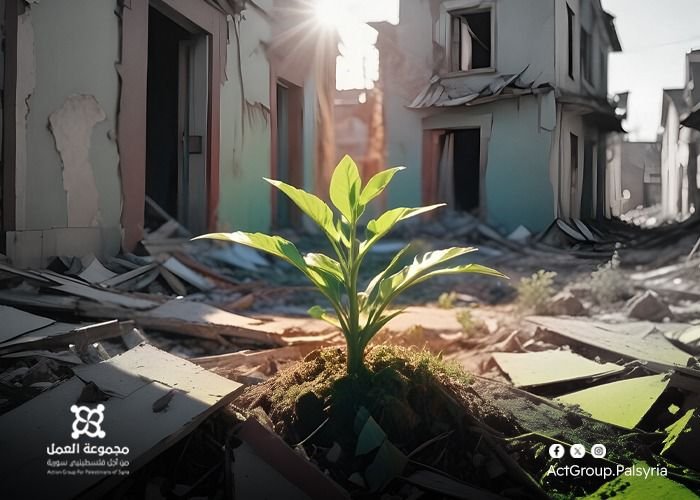
The Palestinian people, described by Mahmoud Darwish as the “people of giants”and those who “raise hope,”have found inspiration in the belief that “on this land, there is what is worth living for.”An initiative has emerged to transform these empty spaces into green zones, serving as the lungs of the camp, after obtaining approval from the landowners.
In one of the diaspora camps, a young man began by planting the newly cleared space next to his house. The house had been demolished, and its rubble removed, returning the area to a virgin state. In an inspiring gesture, the owner of the demolished house requested the young man to plant crops on the land and distribute the yield to poor and needy families in the camp, in memory of his deceased parents.
The transformation began with clearing the space, turning over the soil, and enriching it with organic fertilizers. The land was divided into four agricultural plots, where he planted seasonal vegetables, flowers, and herbs: cucumbers, mallow, squash, and tomatoes in summer; spinach, radishes, parsley, coriander, and lettuce in winter. He also planted aromatic herbs such as mint, sage, Palestinian thyme, and basil. To enhance the area further, he introduced fruit trees like olives, lemons, apricots, peaches, and nectarines.
To protect and define the garden, he surrounded it with barbed wire and planted evergreen trees such as cypress and pine along the fence. Shady zenzelkhet trees were added in the center, creating a serene environment. Additionally, he raised domestic birds such as chickens, ducks, and geese. Unfortunately, some stray dogs attacked the birds at night, destroying their coops, while harmful rodents like rats began spreading in the demolished homes surrounding the garden.
Despite these challenges, this green initiative stands out as one of the most inspiring and impactful community projects. It is a purely individual effort that calls for local community support to replicate similar initiatives across other camps. Organizations like UNRWA must also play a role by providing necessary assistance, combating the spread of stray animals and rodents, and ensuring the approval of former property owners.
The broader community should encourage, promote, and implement similar projects in the vast vacant spaces within the camps. Many families have migrated, leaving empty plots that could be transformed into sources of communal benefit.
This initiative’s significance is manifold: it revives the greenery of the camp, compensating for the fruit trees and gardens lost to neglect or destruction during the war. It brings life and a sense of community back to the camps, offering an oasis for social interaction during hot summer evenings. Furthermore, it contributes to self-sufficiency and social solidarity, fulfilling the Palestinian saying, “The fruits of the home prolong life.”
The example set by this young man is a call to action for all, proving that even in the most challenging circumstances, hope and life can blossom