

The Action Group | Syria
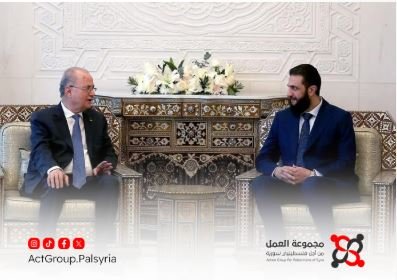
 The visit of the Palestinian Authority delegation headed by Palestinian Prime Minister Mohammad Mustafa to Damascus to meet with the head of the new Syrian administration, Ahmad al-Sharaa, at the People’s Palace, sparked widespread controversy among Palestinian refugees in Syria, as opinions were divided between those who welcomed and those who opposed.Â
A poll conducted by the Action Group for Palestinians in Syria showed that 74% of Palestinian refugees in Syria oppose the visit, considering that the Palestinian Authority delegation does not represent them, which reflects the state of dissatisfaction with the Palestinian leadership and its positions.Â
On the other hand, 13% supported the visit and considered it a positive step that may carry good news fo r Palestinians in Syria, while 8% saw it as a normal diplomatic visit, while 3% described the visit as negative, indicating that it will not bring any real change to the situation.
 Widespread criticism of the delegation’s visit
 Many refugees expressed their lack of confidence in the current Palestinian leadership, accusing it of corruption and incompetence, and criticized the visit as a step that does not serve Palestinian interests. Some also questioned the usefulness of this step in light of the Palestinian division, and the extent of its impact on complicating or resolving the internal crisis.Â
Living conditions in the camps
 Other voices focused on the difficult living conditions suffered by refugees in the Palestinian camps in Syria, wondering about the role of this visit in improving their conditions. Some criticized the timing of the visit, considering it an attempt to normalize relations with the Syrian regime, which is accused by international bodies of committing human rights violations and war crimes.
 Pessimism about the results
 A general feeling of frustration prevails among Palestinian refugees, as many believe that the visit will not achieve any tangible results and will not lead to improving conditions. Others stressed that priority should be given to internal Palestinian issues, such as the political division, combating corruption, and improving living conditions, instead of focusing on external visits.Â
This visit comes at a sensitive time in the Palestinian and Syrian arenas, which increases the state of division over its importance and usefulness.