

Fayez Abu Eid | Action Group
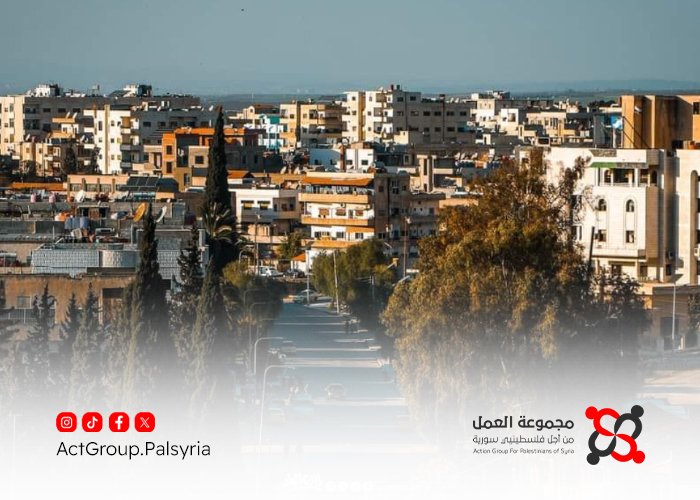
Airport Neighborhood in the Syrian city of Daraa is considered one of the prominent Palestinian communities that has been greatly affected by the repercussions of the Syrian war since 2011. This war has affected various aspects of the daily lives of the residents, including the demographic, educational, and security aspects.
This report sheds light on three main axes: the demographic composition of the Palestinians in the neighborhood, their educational status, and the arrest file that has affected many of them.
1. Demographic census of the Palestinians in the Airport Neighborhood
The Palestinians living in the Airport Neighborhood can be divided into two main groups:
   ”¢Â   The first group:
Includes the original residents who settled in the neighborhood immediately after the Nakba in 1948. The most prominent families that still live in the neighborhood are: the Abu Zard family, known for beekeeping in Daraa Governorate, and other families such as Al-Kaid, Abu Dawood, Abu Sabla, Abu Hamed, Al-Abed, Al-Ghazzawi, Al-Sarhan, Izz, and Melhem.
   ”¢Â   The second group:
Includes Palestinian families who were displaced to the neighborhood from other areas, especially from Daraa camp or from Damascus, since the outbreak of the Syrian revolution in 2011. These families include: Al-Hassan, Tamim, Abu Raqti, Al-Issa, Al-Khalili, Awad, Bilal, Mustafa, Aqab, Abdul Haq, and others.
   ”¢Â   Changes in numbers:
Before 2011, the number of Palestinians in the Airport Neighborhood was small, as it did not exceed a thousand people.
With the outbreak of the war, the neighborhood witnessed a significant increase in the number of Palestinians, reaching about 3,000 people, due to the transformation of many of the neighborhood’s buildings into shelters. However, unofficial local estimates indicate that the number of Palestinians in the neighborhood before 2011 hardly exceeded 1,000 people, while after 2011 the neighborhood witnessed a significant increase in the number of Palestinians, reaching approximately 3,000 individuals, especially after many of its buildings were converted into shelters, while it has currently declined to less than 2,000 people, as a result of internal displacement and migration outside Syria, in addition to the relative stability that the country witnessed after 2018.
2. The educational situation
Palestinian schools in Syria depend mainly on the United Nations Relief and Works Agency for Palestine Refugees (UNRWA), and with the closure of UNRWA schools in Daraa camp, the agency was forced to rent Syrian state schools to accommodate Palestinian students in the evening shift system.
In the Airport Neighborhood, the adjacent Al-Qusour School has been transformed into a dual-use educational center, operating as a school for Syrian students in the morning shift and as Kafr Kanna School for Palestinian students in the evening shift.
Al-Qusour School is only a few minutes’ walk from Airport Neighborhood, making it easy for students to access.
However, educational challenges remain, especially with the deterioration of school infrastructure and the lack of resources to provide quality education.
3. The arrest file
It is one of the most sensitive issues affecting Palestinians in the Airport Neighborhood and Daraa Governorate in general. Since 2011, dozens of cases of arbitrary arrests of Palestinians have been recorded, some of which are related to political activity or suspected affiliations.
Among the Palestinian detainees from the Airport Neighborhood, whose fate has not been revealed to date:
   ”¢Â   Nidal Saleh Al-Kayed
   ”¢Â   Yazan Saleh Al-Kayed
   ”¢Â   Mujahid Al-Sarhan
It should be noted that these numbers are not accurate, as it is difficult to trust the available statistics due to the lack of transparency regarding the fate of detainees, whether Palestinian or Syrian.