

Fayez Abu Eid – Action Group
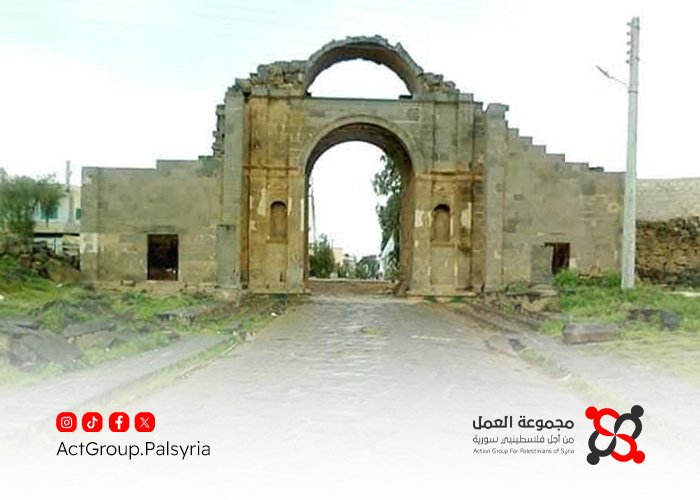
Bosra, that ancient city located in the Daraa Governorate in southern Syria, 40 km from the center of Daraa city and about 140 km from Damascus, which carries within it a history extending for thousands of years, Bosra is famous for its steadfast castle that embraces within it the Roman amphitheater, which is an architectural masterpiece, and it also has many tourist attractions, and it is enough for this city to be honored that the Prophet Muhammad, peace be upon him, visited it in his childhood, before 2011 this city was a destination for tourists from all over the world, but since the outbreak of the Syrian revolution it has become a symbol of steadfastness and defiance.
The history of the Al-Abtali family after the Nakba.
The fact that some Palestinians sought refuge in the city of Busra al-Sham before and after the Nakba confirms the close connection between the Levant and Palestine, as the Quraysh trade journey to the Levant ended in Gaza in Palestine and Busra al-Sham in Syria. Among the Palestinian families who found safe haven in this city are the Haifawe, Ghazzawi, and Nabulsi families. However, these families settled in this area before 1948, and therefore their members enjoy Syrian citizenship. However, there is the Abtali family, whose members still retain their Palestinian citizenship, as a constant reminder of the right of return that has yet to be fulfilled. This family originated in Qalqilya, Palestine, where they were displaced in 1948 after the Nakba that displaced hundreds of thousands of Palestinians. Today, their members number around 50 people, a small number compared to the city’s population of over 30,000. The Abtali family lives in a neighborhood that resembles a neighborhood among the city’s Basarneh residents. This family is known for working primarily in the field of mechanics, a craft they inherited from their ancestors and which has become their primary source of livelihood, in addition to some liberal professions. However, this family, like many Palestinian and Syrian families in the area, suffers from poverty and deprivation. They live in a small neighborhood located between the Basarneh neighborhoods, the city’s original inhabitants, and face significant economic difficulties.
Health and Educational situation
Despite the economic challenges, Busra al-Sham enjoys a relatively good health and education infrastructure compared to other war-affected areas. The city boasts a government hospital and several clinics, in addition to a large number of doctors who have contributed to raising the city’s health standards. However, UNRWA support for Palestinians in the area remains non-existent, both in terms of regular presence and field visits. UNRWA’s material support, whether financial or in the form of food, covers only a small portion of the basic needs of both Palestinian and Syrian families.
In terms of education, Busra al-Sham is famous for its many schools, including a school for gifted students and a vocational school, providing Palestinians with the opportunity to complete their education. However, UNRWA schools, which many Palestinians consider a symbol of quality education, are completely absent from this area and other parts of the governorate, limited to Daraa Camp, Muzayrib, and Jlin. This is despite the increasing number of Palestinians over the years. One Palestinian in Busra says, “I have only seen UNRWA schools on television,” reflecting the elusive dream of obtaining a quality education under difficult circumstances.
The first generation of this family was uneducated, but today they are striving to educate their children by all means possible. The Al-Abatli family, like other Palestinian families in Syria, remains the focus of the Action Group’s efforts to monitor their conditions and concerns, highlighting their humanitarian, living, economic, and educational suffering and conveying them with transparency and professionalism. This family confirmed that we were the first to write about them and document their reality, emphasizing that their liberation from the defunct Assad regime renewed their hope of returning to Palestine, the land of their ancestors.