

Nidal Khalil – Special – Action Group
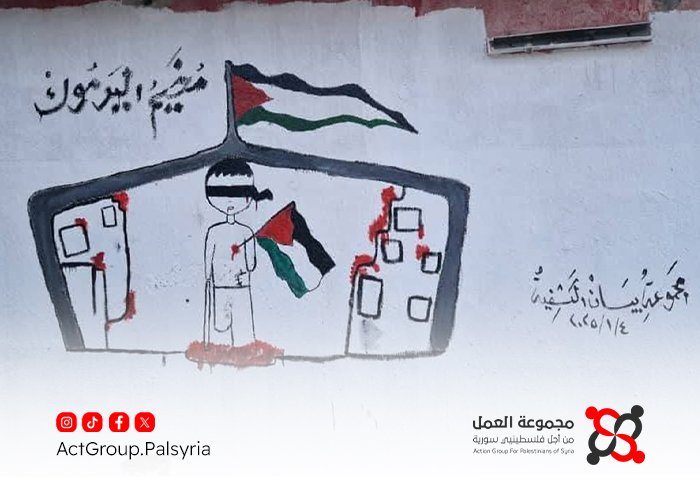
Yarmouk Siege At the time when the siege began to stifle the pulse of life in the camp, the goal was not merely to destroy walls and barriers, but rather it was more like an existential blow that shook the entire entity of society. The scale we were accustomed to in human life vanished, as if loss was the real existence. The successive bombardments led to the interruption of vital supplies, thus announcing the beginning of a chapter of continuous despair and unbreakable steadfastness despite the pain. Amidst these circumstances that penetrate the soul, an urgent need emerged to reformulate memory and identity, as if time itself was rearranging its papers, which prompted activists and artists to search for resistance tools that would transform pain into a creative pulse that would restore to the camp the beauty it had lost, despite all the cracks and fractures.
Tales from the Heart of Yarmouk
Artist Hassan Hassan is one of Yarmouk’s icons, thanks to his embodiment of the experience of torture and his personal suffering. Through his initiative with the “Reaction” group, he launched the “On the Love of the Siege” series, which relied on visual sketches published online to critically and satirically narrate the reality of life inside the camp. Hassan, as his name suggests, was a wake-up call calling the world’s attention to the suffering of the population and the tragedy of the siege.
In 2016, artist Rama Haidar presented her theatrical and literary performance “Desert of Light” at Cornell University. Not content with narrating the experiences of refugees and displaced persons, she elevated her literary text to the level of living testimony that defies oblivion. Through the play, Rama embodied the transformation of pain into an artistic work that elevates collective memory, affirming the ability of art to be a tool of struggle against violence and media silence.
His artistic activity was not limited to the stage and screen, but extended to profound literary discourse. Thaer Al-Sahli excelled in crafting texts of a personal and social nature, most notably “A Letter in the Mail of the Sea and the Desert,” in which he combined poetic depth with critical analysis to document the humanitarian situation in the camp, thus presenting a literary reference that defies the disappearance of memory despite all attempts.
Short story writer Nardine Abu Nabaa documented the suffering of the population through extensive novels, perhaps the most famous of which is “Seven Hard Years.” Her novels conveyed minute details of daily life experiences under siege, shedding light on the dimensions of identity and memory affected by harsh conditions. Thus, the novels became bridges connecting the past and the present, calling for a reconsideration of the concept of human dignity.
In the absence of effective international media, journalists and photographers emerged as the conduits that conveyed the true image of Yarmouk’s suffering. Photographers such as Niraz Saeed, the man who took the famous photos of the “Three Kings,” who was arrested in October 2015 and martyred in tragic circumstances, as well as Jihad al-Shihabi, Fadi Abu Ajaj, Jamal Khalifa, and Ahmed Kousa, risked their lives and courageously documented violations and daily life amidst the destruction. These photographers used documentary photography techniques to convey a visual image that reflects the magnitude of the suffering and documents the facts with complete transparency.
Documentary films have also not been absent from the media art scene. Ahmed Noufal directed “Camp Story,” which presents a comprehensive visual narrative of the Yarmouk experience. The film relies on a methodology of realistic photography combined with narrative analysis, comprehensively addressing causes and consequences, making it an important reference for understanding the human experience under siege.
In the absence of traditional media, independent media initiatives have emerged, led by activists such as Khaled Bakrawi, Bassam Hamid, Ahmed Al-Sahli, and lyad Farahat.
These projects relied on digital platforms and alternative communication technologies, enabling the transmission of live testimonies from the heart of the camp. These initiatives served as a bridge between the camp and the outside world, highlighting the suffering of the residents and expressing their unwavering voice.
Music and visual arts have been an essential part of the cultural resistance in Yarmouk. Artists such as Samer Abu Hashish, Mohammed Anwar Ahmed (Abu Kabi), Mahmoud Tamim, and the Yarmouk Youth Band have used rap as a means of expressing the camp’s suffering. The lyrics and rhythms of the songs were anthems of defiance, expressing pain mixed with hope. The song “Voice of the Camp,” produced by Ayham Al-Ahmad in 2016, embodied this powerful defiance that refuses to surrender in the face of harsh conditions.
The role of visual arts in narrating the tragedies of Yarmouk cannot be overlooked, as Hani Abbas used cartoon techniques to document the bloody scenes that reflect the wounds of the camp. In Europe, Mamoun Al-Shaib transferred the colors of the camp to distant spaces, confirming that visual arts remain a vital means of recording the effects of the siege on identity and collective memory.
The Yarmouk experience embodies painful numbers and statistics about the loss of martyrs and the detention of detainees. However, it also carries within it a living model that calls for rethinking the role of art and media as tools for liberation. Artists, photographers, and media professionals have been able to transform pain into creative resistance, reshaping identity and calling for the struggle for freedom and dignity.
Yarmouk is a testament that injustice cannot extinguish the spark of creativity and struggle, and that every poem, every image, and every scene carries with it an eternal message that humanity will not be forgotten and that resistance will live on despite all challenges.