

Action Group | Nidal Al-Khalil
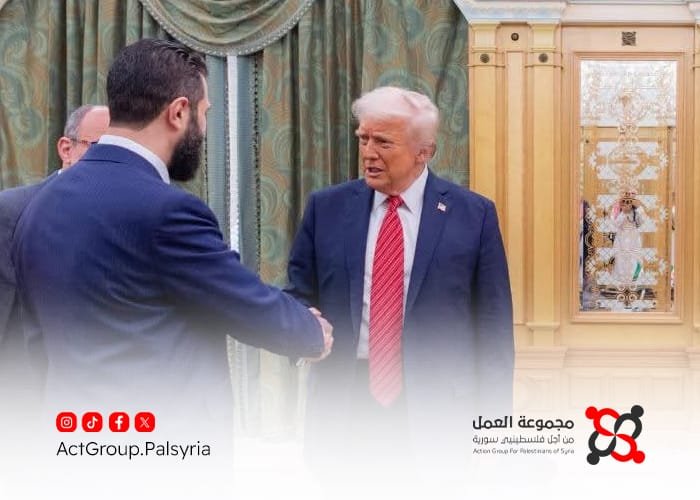
In a meeting described as pivotal, between US President Donald Trump””who has made a strong comeback to the political scene””and Syrian President Ahmad al-Sharaa in the Saudi capital, the issue of Palestinian refugees in Syria was raised suddenly, in a tone that sparked considerable controversy in diplomatic and human rights circles alike.
In a brief statement issued by the White House following the summit, President Trump urged the Syrian leadership to deport Palestinians involved in “terrorist activities,” without providing any additional details or naming specific organizations.
The statement, despite its brevity, was enough to spark widespread debate about the nature of these demands, the context in which they were made, and the humanitarian and political consequences that could result from their implementation.
*Loose Classification and Absence of Standards:*
Notably, the US statement used vague terms such as “Palestinian terrorists” without providing a precise definition or legal framework that would define what this description entails. This prompted many to question: Are we talking about internationally designated armed elements?
Or is the classification subject to US political discretion?
Or does it simply open the door to collective measures that could affect thousands of innocent people?
In the absence of any clarification, it became clear that the US administration was re-presenting the Palestinian refugee issue in Syria, not from a humanitarian or legal perspective, but rather as a purely security issue””recalling a familiar pattern in US foreign policy, where “national security concerns” are presented as a cover for ignoring international norms.
*Absent reactions”¦ and a silence that speaks volumes.*
The Syrian Interim Government has not issued any official statements regarding the American request. This came as no surprise to observers who believe that Sharaa, who is trying to establish himself in a changing political equation, may not be in a position that allows him to confront Washington directly.
Palestinian factions operating in Syria, both traditional and independent, have also remained silent, or have made do with brief, unofficial comments. However, sources inside the refugee camps have expressed growing concern that this American statement could become a prelude to widespread targeting campaigns that may affect the remaining Palestinians who survived the war but remain trapped in its crisis.
*The reality of the camps: double vulnerability on the ground.*
Palestinians in Syria today live in deteriorating conditions: collapsing infrastructure, a lack of services, widespread poverty, and the absence of a political horizon.
For camp residents, talk of “deportation” does not seem theoretical; Rather, it is a bleak scenario looming on the horizon, especially since many of them lack official papers, no alternative country to receive them, and no legal system to protect them from arbitrary decisions.
Human rights reports indicate that any move to deport Palestinians from Syria””especially if it is not preceded by fair investigations and legal safeguards””could amount to a flagrant violation of international law, including the 1951 Refugee Convention and the Geneva Conventions.
*The Palestinian Refugee: A Bargaining Chip or a Human Being with Rights?*
Since the beginning of the Syrian conflict, Palestinian refugees in Syria have paid the price twice:
once because of the war that has ravaged the country, and once because of the political marginalization that has rendered them a permanent footnote in every negotiation.
Today, they appear to be being used once again as a bargaining chip in US-Syrian negotiations, far from any real vision for a radical solution to their situation.
In a conversation with a human rights activist working on the Palestinian issue, he said,
“No one is asking the question: What will happen to those who are deported?
Where will they go?
Who will protect them?
All that is being said is about security and interests, while the real people are being left out in the open.”
In light of all this, there has so far been no clear position from the United Nations or from UNRWA, the agency primarily responsible for monitoring the affairs of Palestinian refugees.
Some human rights organizations have issued warning statements, but they have fallen short of the required level of pressure, and many fear that these measures””or parts of them””will be passed amid international silence similar to that which accompanied previous phases of Palestinian displacement.
In a world where interests are increasingly at the expense of human rights, Palestinians once again appear trapped between political discourses that classify them as a threat and local contexts that lack the capacity or desire to defend them.
What was discussed at the Riyadh summit cannot be separated from a longer process of marginalization and politicization, but it is a pivotal moment that calls for serious consideration.
The question that remains unanswered, despite all the uproar, is:
Will Palestinian refugees remain permanently hostage to major decisions made above their heads, without being present even in the narrative of their survival?
Or is it time to reframe this presence as a humanitarian issue that deserves to be addressed beyond the considerations of temporary deals?