

Nidal Al-Khalil – Action Group
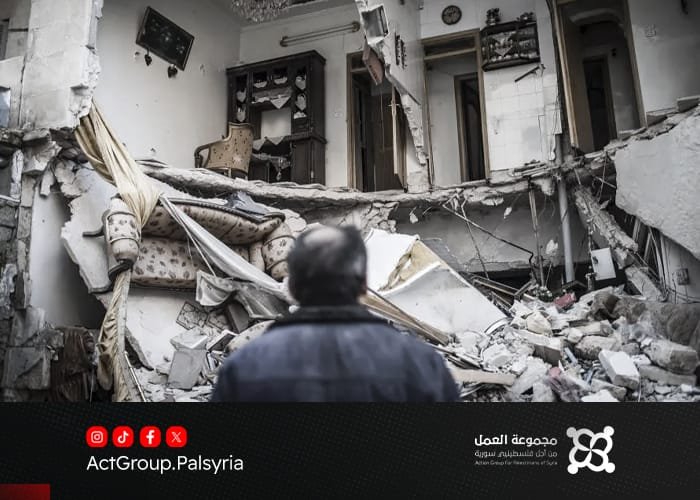
When you approach the shattered walls of Yarmouk Camp, you hear only the echo of its ruins. Ahmed touches the remains of cracked bricks at the corner that, a few years ago, was a wall separating him from a family kitchen brimming with memories. He didn’t come in search of the wall, but rather of his lost copy within it. At a time when the camp has become an empty theater, its lights extinguished and the audience remains seated, waiting for a show that ended years ago. Today, there is no return to home, but rather to a legal text demanding proof of ownership, residency documents, and a security clearance that speaks not of life but of its possibilities.
The new authority imposes standards not much different from a maze – papers burned, memories displaced, and employees “temporarily unavailable.” In Yarmouk, no one actually returns home, but rather returns to their idea of home, to an old image, and to a question that has yet to be answered: What are we really returning to?
*How is the memory stone restored?*
In Yarmouk, the return is no longer to a “home,” but rather to a legal file. On refugee Ahmed’s desk lies a file preserved in transparent plastic: a 2008 ownership document signed by a municipality that no longer exists, a temporary residency permit with conditions that do not preserve his dignity, and a security clearance that speaks not of life, but of the “ability” to live.
Ahmed says: I have begun to confirm my existence with an official document instead of my presence on the ground.
*The stone that inhabits the human being.*
Restoration here is not limited to the walls, but the human being himself is in need of profound restoration. In the corners of the destroyed room, Sami stood contemplating what remained of his shelves, bearing what looked like a conditional return permit. “It is not enough that the law gives me the right to return,”he said. “Rather, I want to return with my personality and courage.”Official figures indicate that 160,000 Syrian Palestinians lived in the camp, of whom approximately 15,000 have returned. But the numbers do not tell the story of the suffering of those left behind: memories shattered before the stone and lives torn apart between documents and those invisible barriers.
*The law as a broken window in the new politics.*
The law turns into a seductive woman who promises you a return, then smiles in your face, demanding that you bring a property deed from an office that collapsed under the rubble of war.
She imposes a rubble cleanup fee and promises you electricity if you pay in advance. When you try to appeal the expropriation decision, you’re told there’s no committee to hear your appeals. Officials disappear like papers in the vaults of burnt archives.
*The refugee who became a document*
After years of successive displacement. The identity of a Palestinian Syrian has become a file. In Homs, some consider him a “documented refugee.” In Daraa, he stands in the “conditional return queue,” armed with a photocopy of a marriage contract proving his one-day presence there. Returning to a place is no longer so much an attempt to reclaim a role whose rules have changed. Legal and relief organizations have replaced the factions and speak a language known only to judges and officials.
*Beyond the Silence:*
When Salim returned from Lebanon, he discovered that his house was still partially standing, but the neighborhood was empty of neighbors and the school where he taught was closed. The calm of exile asked him, “Is home walls or familiarity?”
Then he wondered, “Is a Palestinian Syrian still Palestinian, or has it become just a story suspended in a UN report?”
At that moment, he understood that the camp is not a place to be rebuilt, but rather an idea to be preserved, and that restoration is a new resistance told with a stone planted in the rubble.
*Yarmouk as metaphysics:*
Today, a Syrian Palestinian does not have a home in the traditional sense, but finds himself drowning in files, waiting lists, and conditional privileges. He sees the camp as a shared memory and geography that can only be restored with the courage to remember.
He understood that the catastrophe lies not only in the destruction, but in the oblivion. Thus, the Palestinian builds his own protective wall, stone by stone, desire by desire, out of respect for his dignity and in search of a life lived without permission.