

Fayez Abu Eid – Action GroupÂ
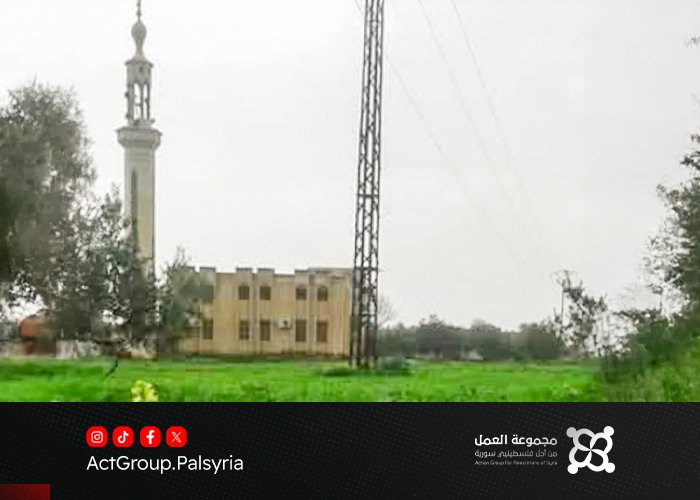
A single family in a remote village in the far southwest of the Syrian province of Daraa, Ma’ariyah is one of the forgotten border villages located in a sensitive border triangle between Syria, occupied Palestine, and Jordan. The village overlooks Wadi al-Raqqad, a tributary of the Yarmouk River. Its population of approximately 3,000 people relies on agriculture and beekeeping, but they suffer from the deterioration of basic services and the restrictions imposed by the Israeli occupation.
Amidst this reality lives the Abu Ja’ada family, the only Palestinian family in the village, which was displaced from the town of Samakh in the Tiberias district of Palestine in 1948, ending up in this remote village. Despite the passage of more than 75 years since the Nakba, the family still maintains its Palestinian identity and faces the challenges of survival in an area witnessing increasing Israeli encroachment.
*Geographical location and life under occupation:*
Ma’ariyah is located in the Yarmouk Basin, surrounded by several villages such as Abdin, Beit Ara, and Koya. Bordered to the west by the occupied Golan Heights and to the south by Jordanian territory, the village suffers from “harsh isolation.”
Following the withdrawal of Syrian forces from the area in recent years, Israeli incursions have intensified, with the occupation forces occupying the “Al-Jazeera Barracks” site west of the village and imposing restrictions on the movement of residents, especially in the valley, which contains fertile agricultural lands. The village is also frequently targeted by drones, making daily life fraught with danger.
*The story of the Palestinian family:*
When did it begin? The family’s origins go back to the town of Samakh near Lake Tiberias, which was destroyed by the Israeli occupation in 1948. After the Nakba, the family settled in Ma’ariyah, which was then a remote agricultural village. Unlike most Palestinian families who preferred to live in camps such as Daraa Camp or Muzayrib, the Abu Ja’ada family chose to remain in the countryside, where they own agricultural land.Â
Today, the family consists of five brothers, each with their own family, totaling about 25 people. Some work in agriculture, while others moved to Daraa city for work. Among them is a school employee (one of the family members works as a bellboy at the local school). There is also a restaurant owner in Daraa, and there are farmers who depend on their lands, but the occupation’s ban on access to the valley has deprived them of a large portion of their income.
*Economic Reality:*
Agriculture was once the primary source of income, but the occupation’s prevention of access to the valley has led to its deterioration. Residents there rely on early-ripe crops, which has worsened their situation as they await a solution. Many view this with fear, tinged with doubts that the right of return may once again seem like a dream, forcing Palestinians and non-Palestinians in the village of Ma’ariyah to wait for an even longer period.Â
Some residents also rely on beekeeping, but it is no longer sufficient due to the lack of pasture, especially after the Israeli occupation seized control of the valley and prevented beekeepers from accessing it.
It is worth noting that Ma’ariyah has witnessed a massive exodus, with more than 40% of the village’s residents emigrating to Damascus or Daraa due to the lack of opportunities.
*The educational reality:*
Palestinians in the villages on Syria’s western border say they have never known UNRWA schools. Geography is a barrier to isolation, yet education struggles with difficulty through just two schools: an elementary school and a middle school, both of which attempt to break the barrier of oblivion.
The elementary school is a two-story building with seven classes, each with approximately 30 students.Â
The middle school is a one-story building with six classes up to the tenth grade, where formal education abruptly ends. After that, students are left with two stark choices: either leave in search of a secondary school in neighboring villages or cities (if one is available), or drop out of school and resort to early work or marriage.
The tenth grade is considered the temporary end for many Palestinians from the border villages, as there is unfortunately no full secondary education in the village of Ma’ariyah. Science students may find an opportunity to enroll in other schools, while literary students face a harsher fate. After the tenth grade, they go to the village of Al-Shajara, or Koya, as it is called locally, in reference to the lack of opportunities. Even if there are schools nearby, the costs and transportation make it difficult for the residents, most of whom live on simple farming or fragile daily work.
*Service Reality:*
There is no local bakery in Ma’ariyah village, and residents rely on bringing bread from outside the village. Healthcare services are also limited, with only one pharmacy, and village doctors work either in Daraa city or in the neighboring town of Al-Shajarah.Â
Water is one of the most pressing issues facing Ma’ariyah residents, including its Palestinian population. Consequently, the village relies on water tankers, which are in high demand in the summer, with the cost of a tanker truck exceeding 150,000 Syrian pounds. Unlike other villages that have begun to return to life after the fall of Assad, there is no regular water network. This exacerbates the suffering of residents, especially with the high cost of transporting water from Daraa.
Transportation to and from Ma’ariyah is similar to most other villages, with residents relying on a single service bus that transports them morning and evening to Daraa or Damascus. Dr. Muhammad Ahmad Al-Ali, a resident of the village, suggested “adding an internal water pipeline from Al-Shajarah that extends to Ma’ariyah, especially during exam days,” emphasizing, “because I know how much people suffer because of this problem.”Â
Current transportation fares: – From Ma’arriyeh to Daraa: 15,000 Syrian pounds, and from Ma’arriyeh to Damascus by microbus: 50,000 Syrian pounds. This proposal, he said, could alleviate the suffering of residents and provide a practical solution during critical times such as exam days.
*Promising talents*Â
Despite being repeatedly forced to flee, most recently to Daraa under difficult circumstances, the Palestinian girl, Mira Saleh Abu Jaada (9 years old), from the Abu Jaada family, was able to excel in mental arithmetic competitions and achieve a highly prestigious position, becoming a model of determination and talent despite displacement. Her story raises a painful question: How many Palestinian children are stuck on the borders, waiting for someone to take them by the hand and transform their creativity into achievement?
*A tireless search and tracking journey*
The Action Group for Palestinians of Syria works tirelessly to track down forgotten Syrian Palestinians, especially in remote villages like the Abu Jaada family, who lived far from the spotlight. Despite the difficulty of reaching them, the team was able to identify them through individual efforts, such as a hint from a local teacher. The villagers were surprised by our interest in this family, which confirms the lack of media attention. One resident said, “Even the governor might not know about this village, so how about a single Palestinian family?” Nevertheless, the group is committed to shedding light on every Palestinian, even if they are alone in the extreme, because their suffering deserves to be told.