

Action Group | Damascus Countryside
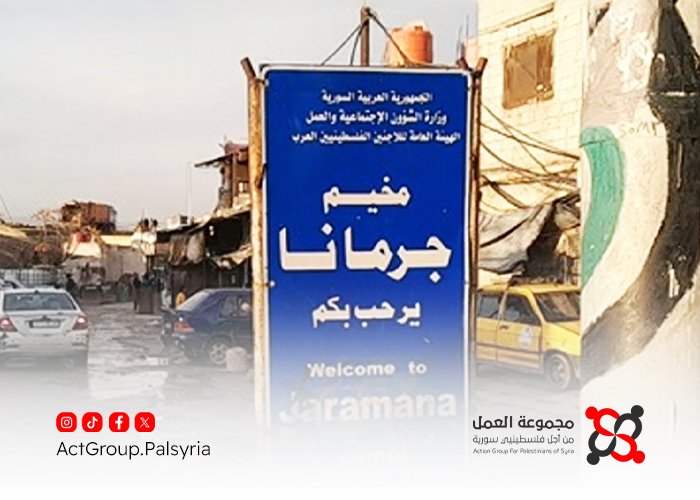
Recent statistics, prepared by the Hamat Voluntary Committee based on a map from the General Authority for Palestinian Arab Refugees, revealed precise details about the demographic and social composition of the Jaramana Palestinian refugee camp in Damascus Countryside.
The data showed that the number of families in the camp reached 3,656, with a total of 13,804 individuals. The estimated number of Palestinian refugees before the Syrian revolution (2011) was around 14,000, rising during the war to 20,000-25,000 due to waves of displacement from other camps.
Population distribution and major challenges
– Al-Tahrir neighborhood is the largest with 863 families (24%), while Bustan Abdo is the smallest with 108 families (3%).
– 25.2% of households are subsisted by women, compared to 74.8% subsisted by men, highlighting the suffering of families who have lost their breadwinners.
– 43 forcibly disappeared persons were recorded, most of them due to arrests by popular committees or security checkpoints.
– Syrian Palestinians constitute the majority, with 2,882 families, followed by Syrians (741 families), then small numbers of Jordanian, Lebanese, and Iraqi Palestinians.
The Hamat Committee emphasized that the goal is to update the data to improve humanitarian services, especially with the deteriorating economic situation and the increasing number of female-subsisted households. Mohammed Al-Ali, a member of the committee, said: “These figures help organizations target aid fairly, but the situation requires urgent international support.”
Although UNRWA provided essential services before the crisis, camp residents complain of declining support and difficulty accessing healthcare. Local organizations indicate that 70% of families rely on emergency food aid.
It is worth noting that Jaramana camp faces severe overcrowding and damaged infrastructure, making it one of the camps most in need of sustained humanitarian intervention.