

Fayez Abu Eid – Action Group
In the heart of the western countryside of Daraa Governorate, where fields stretch out and villages are scattered, two villages stand like distorted twins, sharing the same story but with different names: Al-Muzayri’ah and Al-Ajami.Â
These two villages are not merely points on a map; they are a living tableau reflecting identical suffering, where the alienation of their location is intertwined with the difficulty of accessing education, making the dream of studying in UNRWA schools a distant, almost impossible, aspiration.
In Al-Muzayri’ah, in the western countryside of Daraa, which has become a refuge for displaced people from the occupied Syrian Golan Heights and their Palestinian brethren, the suffering begins with the sunrise.
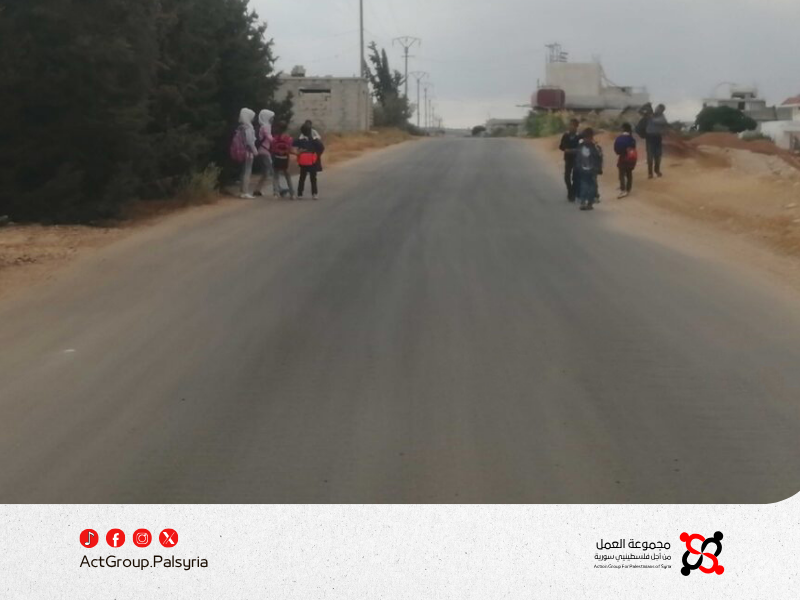
As the Palestinian students from the Faour and Ibrahim families gather on the outskirts of the village, at the junction leading to their desired educational world, a station after which an arduous journey begins, the “service taxis,” that primary means of transportation, refuse to enter the village, leaving the students with two bitter choices: either to walk for a distance of at least three kilometers to reach the main road to Jillin, and then travel other kilometers to reach the UNRWA schools in the town of Jillin, where the Asqalan school is located near the Jillin camp.
Or they bear the exorbitant financial burden of hiring private transportation, a cost that most Palestinians and Syrians living in that village cannot afford. They are either simple farmers or employees whose salaries barely cover a small portion of their numerous needs.
When the Action Group contacted a number of Palestinian students in Al-Muzayri’ah, they confirmed that this journey is difficult and arduous. It requires them to wake up at six in the morning or earlier to walk, and at that time there is no transportation available, such as motorcycles, forcing them to walk. When they reach the main road, the minibuses are full of passengers, and they cannot find anyone to give them a ride, so they have to continue walking to school. This is the case for the morning session at the Asqalan School, which is divided into two sessions: a morning session called Arraba School and an afternoon session for the preparatory stage called Asqalan School.
This same suffering is mirrored in another nearby village on the other side of the Jillin Valley: the neighboring village of Al-Ajami. Located 7 kilometers from Al-Muzayrib, Al-Ajami is a beautiful village inhabited by Palestinian families such as the Aqrabawi, Shteiwi, and Sawalmeh families. Despite its beauty, it has only one primary school, forcing Palestinian and Syrian students to travel to neighboring villages for their education.
These students face daily hardship due to a lack of transportation. Buses from the western countryside are full and do not stop for them, forcing them to either walk long distances or wait for extended periods.Â
The sight of these students walking early each morning towards UNRWA schools has become a familiar one, telling the story of their struggle for education.
It’s a similarly arduous journey for them; they are forced to walk approximately three kilometers to leave their village and reach the main road. This recurring daily scene is not merely a round trip, but a test of resolve and willpower, which the length of the road and the refusal of minibus drivers to enter the village transform into a daily nightmare.Â
This strange similarity, which may escape many notice, extends beyond the geographical boundaries of their suffering; it reaches the very core of their lives. Both villages are located in the western countryside of Daraa, and both are home to struggling Palestinian families who pin their hopes on their children’s education in UNRWA schools. These schools are considered by them to be superior or private institutions, distinguished by their rigorous curricula and highly qualified teaching staff””a quality lacking in many government schools, which suffer from a severe shortage of teachers and deteriorating infrastructure.Â
This strong motivation has led the residents to cling to the dream of studying at UNRWA schools, despite all the difficulties, taking advantage of the schools’ proximity to their villages. However, geography stands as a barrier preventing the realization of these aspirations.Â
The villages of Al-Muzayri’ah and Al-Ajami are twin villages, but this tragic similarity pushes many families to the brink of a painful decision.Â
The Palestinian family in Al-Muzayri’ah, like the Al-Ibrahim family, who are pleading for help to save their children’s future, faces the same circumstances as the Palestinian family in Al-Ajami, like the Al-Sawalmeh family.Â
The accumulated burdens and arduous journeys have forced many parents, against their will, to withdraw their children from schools entirely or enroll them in state schools that they do not trust, threatening the loss of an entire generation in the absence of practical solutions.
Therefore, through this report, the Action Group appeals to the relevant authorities to intervene urgently to provide dedicated transportation for these two villages, or to compel bus drivers to enter the villages to transport students.
Ensuring students’ access to UNRWA schools is not merely a transportation service, but one of the fundamental rights of education that must be guaranteed for this generation, which has suffered from prolonged neglect.
The villages of Al-Muzayri’ah and Al-Ajami tell the same story, a story of striking similarity in suffering and challenges; they are two sides of the same coin of neglect and oblivion.
The suffering of the Palestinian students there is not just a passing transportation crisis, but rather the plight of an entire generation deprived of its right to education. These students are not asking for the impossible; they are simply waiting for a solution that will spare them the hardship of the journey and bring them to their classrooms, transforming their dreams from a scene on the roadside into a reality in the classroom.