

Action Group – Special – Mohammed Al-Hassan
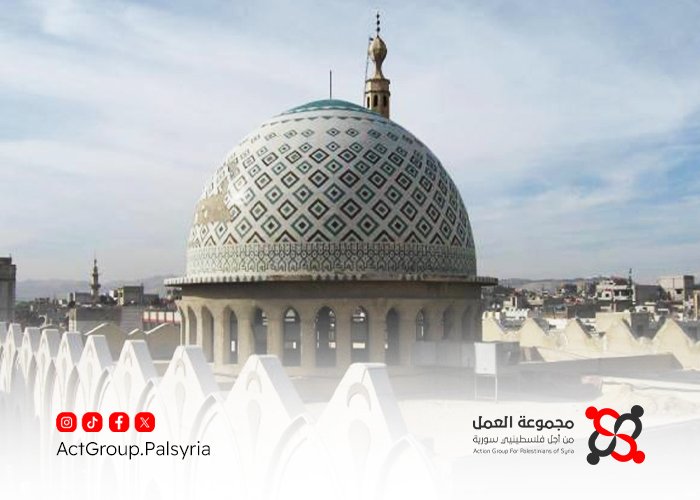
The Yarmouk camp for Palestinian refugees in Syria represents a great symbolism as it was the largest gathering of Palestinian refugees in Syria before the Syrian revolution and was full of life and events and activities. It also included many mosques, some of which had a great impact on the souls of the camp’s residents and its youth in particular, and was a starting point for many revolutionary activities. It was also a home for displaced people from areas neighboring the camp in the early days of the Syrian revolution, before the regime targeted it and destroyed most of it. Perhaps the most famous incident was when MiG planes bombed the Abdul Qader al-Husseini Mosque, which remains an unhealed wound despite the passage of more than 12 years.
The regime did not allow the camp residents to return to it.
In Yarmouk camp, there were 15 mosques distributed throughout its neighborhoods and streets, and all of these mosques were completely or partially destroyed, bombed, and vandalized, starting with Al-Bashir Mosque located at the camp gate, which the regime turned into a military barracks during its siege of the camp in 2013, passing through Al-Wassim, Al-Safadi, Al-Quds, Al-Rijula, Salah Al-Din, and other mosques in the camp. Despite the “liberation of the camp,”as the former regime previously claimed, it did not allow its residents to return to it, and it placed obstacles and complications that prevented their return, and only a few of them returned with great difficulty. It also gave thieves free rein to practice their hobby of “looting,”from which nothing was spared from the infrastructure of buildings and facilities, some of which were steadfast or partially damaged by the fierce battles that the camp witnessed. Many of the buildings that were spared from the bombing fell as a result of theft “looting,”as they were They pull iron bars from ceilings and foundations…
Yarmouk Camp between 8 years… and 3 months
Since the fall of the camp to the regime in 2016 until the fall of the regime in late 2024, there was no sign of life in the camp. The former regime did not move a finger to repair the infrastructure or encourage the residents to return to the camp, but on the contrary, people would enter to check on their homes to see if they were still standing or if they were destroyed by the regime’s bombing. They could not live with the extremely difficult reality imposed by the regime, so most of them were forced to remain in their places of displacement, except for a few of them who preferred to return to the camp and endure the severe suffering. They would bring their basic needs from the Zahra area and then return to their cave in Yarmouk Camp to stay for a few more days…
Mosques are ready and others are on the way
Because the mosques were the starting point of the revolution, the regime poured out its anger and deep-seated hatred on them and their people, and there was no initiative to restore or rebuild any mosque in Yarmouk Camp or in other areas throughout the past years, but during the past two months After the victory of the Syrian revolution, we find that life has returned to a number of the camp’s mosques, most notably the Abdul Qader Al-Husseini Mosque, the icon of Yarmouk Camp, which is located in the heart of the camp and is considered the largest mosque in it. Its lower floor was prepared in the most splendid way, with the effort and initiative of the people and a group of people of virtue, to be ready to receive worshipers in the holy month of Ramadan. The same is the case with the Palestine Mosque, and the Al-Safadi Mosque, which is located in the Al-Taqaddum neighborhood affiliated with Yarmouk Camp, has been restored and furnished at the expense of a charitable organization, and work is underway in the Al-Wassim Mosque, the Al-Rujulah Mosque, and the Al-Quds Mosque.
Mosques that were managed by the security branches
The mosques of Yarmouk camp were like other mosques in Syria, controlled by the Ministry of Endowments of the defunct regime, along with the security branches, which controlled them and appointed whoever they wanted in them and dismissed whoever disobeyed them. Many imams and preachers were subjected to harassment and security prosecutions, some of whom were arrested by the regime, and some were killed under torture, and the rest chose to emigrate out of fear of the brutality of the regime. Unfortunately, there were some imams who were considered to be loyal to the regime and who defended it vehemently, so they left a black mark on the history of the camp. These people are only remembered badly and are ostracized by the people of the camp. The best evidence of this is the popular uprising on social media that followed the appointment of Sheikh Muhammad al-Omari as a temporary imam and preacher of the al-Nadheer Mosque in al-Hajar al-Aswad, adjacent to Yarmouk camp, which prompted the new administration to cancel the decision only one day after it was issued. Al-Omari was a former imam and preacher in a number of mosques in Yarmouk camp during the regime’s era and had close relations with the regime’s security services. He defended Fiercely about the regime despite the crimes it committed against its people in Yarmouk camp.
The Ramadan atmosphere in the camp was brilliant.
The Ramadan atmosphere is only known to those who lived in the heart of the camp and experienced the spirit that pulsated in the camp and its people, as the month of Ramadan was a month of visits between family and friends, solidarity between the rich and the poor, and a spiritual opportunity for the lost to return when the minarets resounded with the Takbeers and the voices of the Qur’an rose in prayers. It was also a season for educational circles and charitable initiatives that filled the corners of the camp, in addition to being a commercial center full of distinctive stores that were frequented by many people from Damascus who were not camp residents. This unique initiative and other events and activities aim to restore the luster to Yarmouk Camp, which it has lost for the past 14 years, turning into a ghost town full of darkness, after it was once vibrant with life. It tells its people to return to your camp and launch appeals to international organizations, relief institutions and influential initiatives to stand with Yarmouk Camp and restore the smile to the hearts of its people.